Does Size Matter?

I think I can confidently say that Overflow really enjoyed the little challenge proposed by Logiker at the end of 2023 with the Vintage Computing Christmas Challenge.
For context, when computers started to become powerful enough in the mid-90s, technical limitations no longer made much sense in the demo scene. Logical limitations were then used to define multiple demo categories.
This type of limitation is inherited from the oldschool era, as there were already BASIC competitions with a "maximum of 2 lines" in the early 80s, notably in the Hebdogiciel magazine:
 XavSnap
The most common logical limitation consists of restricting the allowed code size to create an enduring masterpiece. The smaller the size, the more complex things become depending on the platform and what one wishes to achieve.
There are thus demo categories of 16 bytes and many variations. The most renowned are often productions of 256 bytes, 4 kilobytes, and 64 kilobytes, but categories can be created at will.
The lower the maximum allowed size, the harder it becomes to offer a production of equivalent quality to the same production made without this constraint. Below a certain size, it becomes impossible to "cheat" by using a data compressor. This is true once the space occupied by the production and its built-in decompressor breaks even. To calculate this balance, it is not just about counting the size of the compressed code + the size of the decompressor, but one must account for the code that the uncompressed demo would take to scatter bits of code throughout memory (which the decompressor does implicitly).
An emblematic demo is certainly the Elevated demo (Windows) made in 4 kilobytes, which caused a stir upon its release in April 2009 by popularizing this demo category, even beyond the demoscene:
Demo Windows Elevated (4 k)
Many other demos followed, including this one in April 2018:
Below a certain size, and depending on the platforms used, adding sound or music consumes the precious bytes needed for the graphics effect, but successful symbiosis does exist.
Finally, there are also defined production categories, such as the production of a still image or the production of music alone.
Back to the CPC, Overflow had already excelled in the genre in 2012 with a 4k production that featured a beautiful plasma. The title of this demo ("Yet Another Plasma") already indicated that this is an effect that CPC enthusiasts never tire of.
 2015-03-06 19:05:49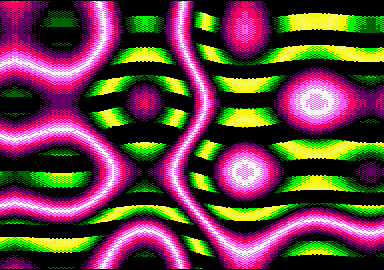
A 256-byte demo came out 1 month later, in November 2012, with another plasma. Quite something! A few kind souls commented on it on the Pouet portal, talking about the "demo spirit" to explicitly reference Overflow's demo. Friendly atmosphere!
The Lovebyte is an event celebrating this type of challenge and focused mainly on productions of 256 bytes and less. The event is followed on the Twitch channel by many enthusiasts.
In 2024, it was during the weekend of February 9-11, 2024 that the various productions were presented. On CPC, there were several productions of different sizes and categories.
I apologize in advance if I'm missing any on CPC. Some went by quickly and are not yet available on the Pouet portal.
BSC (Beta Soft Cologne) presented an experimental "256 bytes" musical production named "Synfonee" which I find very interesting and particularly striking for the CPC. They also participated with a "128 bytes" named "Pattern Mash" which lives up to its name.
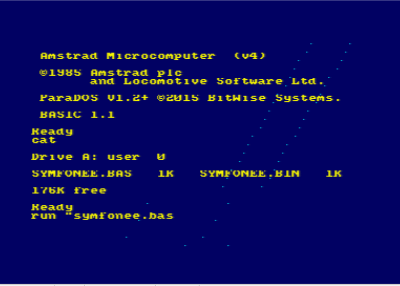
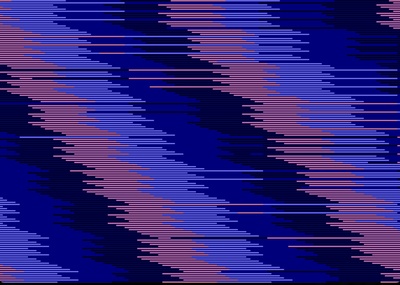
Optimus, for their part, presented no fewer than 4 productions of different sizes. A first one of 32 bytes named "Fizzy" which left me somewhat perplexed. A second one of 64 bytes named "Sea Pyra" with a scrolling landscape that leans more toward pyramids than waves in my opinion, a third one of 128 bytes named "Pond" showing an animated and striking simulation of concentric waves, and finally a 4th of 256 bytes named "Periergoid", which features several effects including fractals.
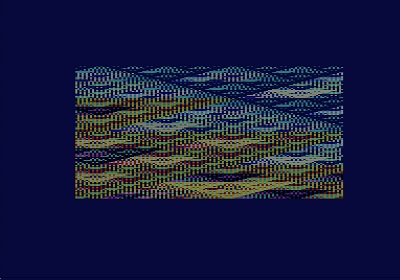
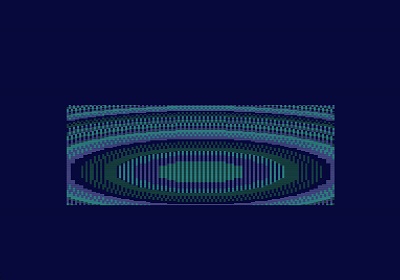
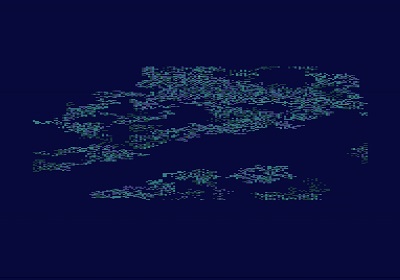
Madram presented a 256-byte production named "Chernobyl Z86" which features a line display with color cycling in the style of what could be found on a demo disk that came with the CPC when it was sold, and another of 1024 bytes named "Conscience" which I haven't seen yet.
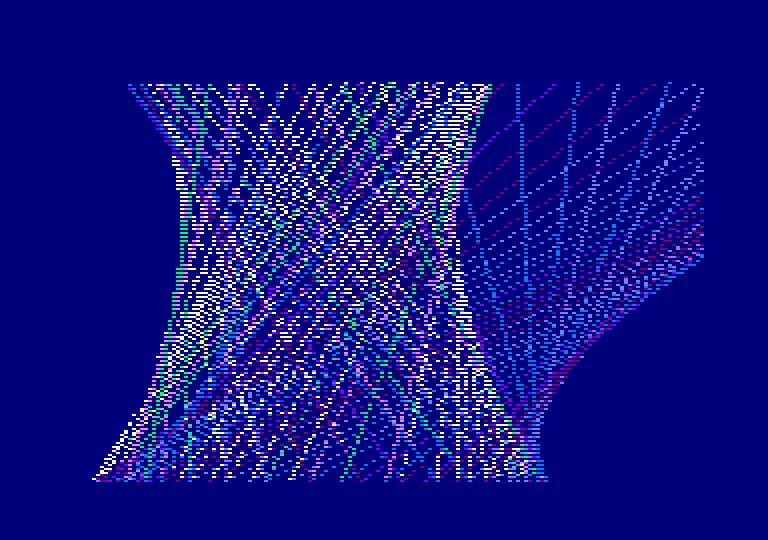
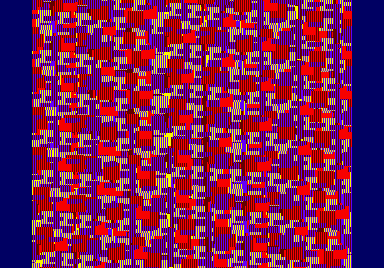
Overflow presented 2 productions of 256 bytes each, named "Logonite" and "Plasmine" respectively:
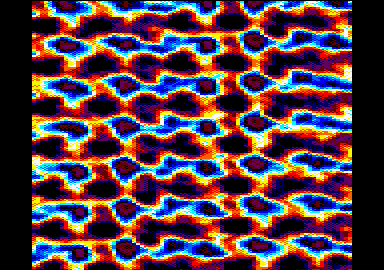
The making-of of each production is available for the curious.
The first one explains how they managed to fit a "mini-Logon's run musical" into these 256 bytes. Musical is however quite a generous term. Shap would agree with me on that!
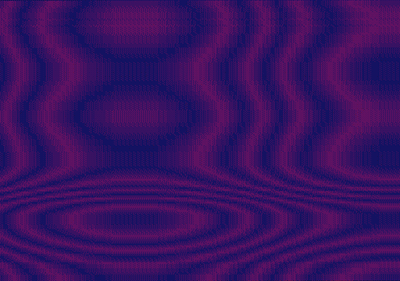
The second making-of explains the method used to revisit a new type of pleasant-looking plasma on the CPC, still in 256 bytes.
For those wishing to delve deeper into optimizations, there are discussion spaces on these topics, notably on the Sizecoding Discord. Chapter 23 of the Compendium can also be quite helpful.
Lovebyte is in the air...
Congratulations to all the participants reading this!
Longshot / Logon System